
Water Utility Climate Alliance
Understand
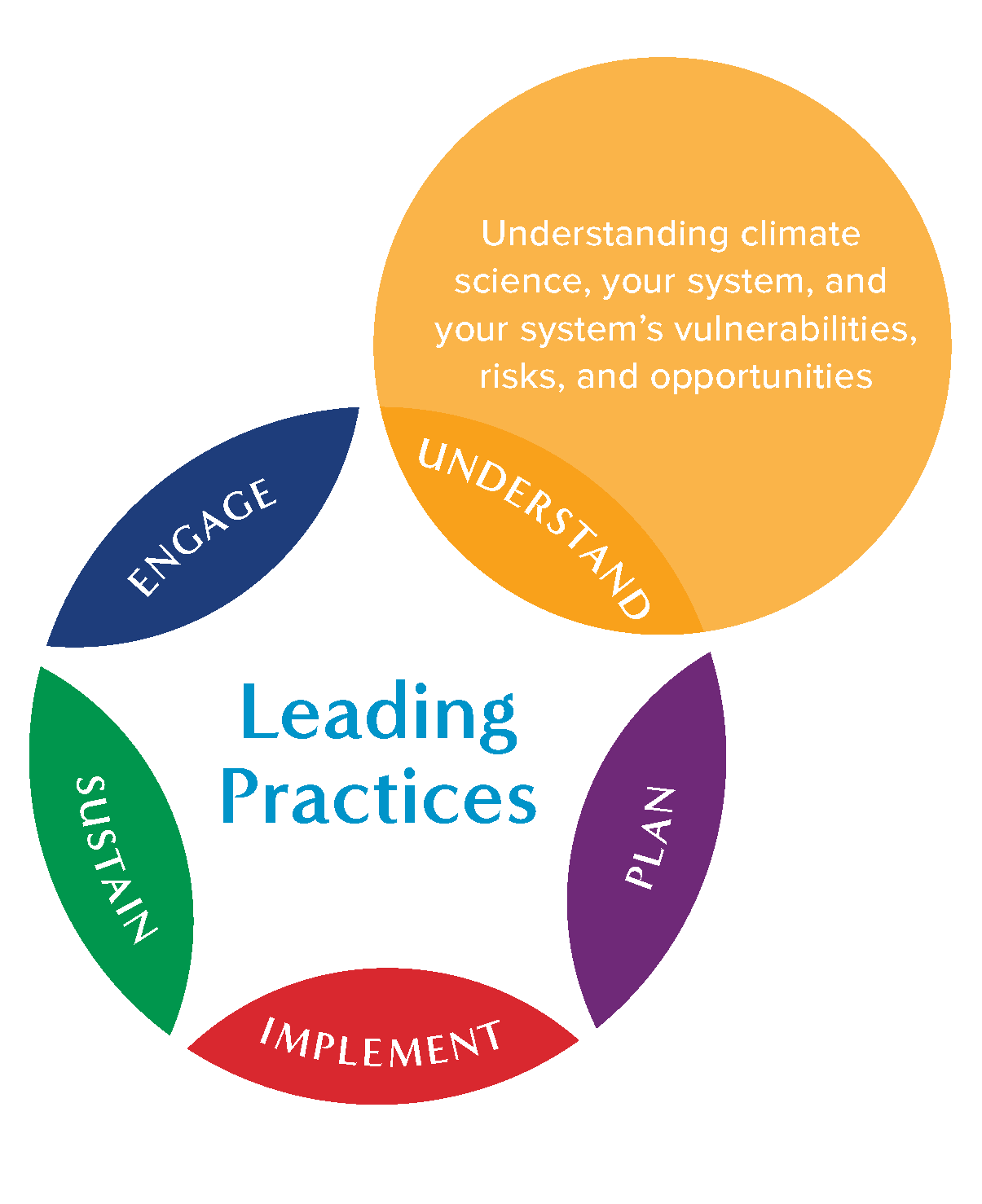
Understanding is continuous and foundational to climate adaptation work. Knowing more about climate change science, how your system functions along with its underlying conditions and key vulnerabilities, provides valuable context to assess future risks and opportunities for adaptation actions. Leading practices in the UNDERSTAND action area illustrate ways to facilitate better understanding.
In the UNDERSTAND action area, leading practices include:
UNDERSTAND
Invest in understanding climate science
Many things can motivate investment in climate adaptation, including climate champions, natural disasters or crises, peer and public pressure, personnel changes, personal observations of change, and access to new knowledge. Leverage the motivational opportunities that fit your circumstances.
Example: Learning about climate change science
Climate change science underlies our understanding of the impact climate change will have on our water systems. Knowing what the science says about local and regional temperature increases, precipitation changes, snowpack declines, and changes in streamflow timing can help you better navigate available climate information and how it might be useful in decision making. WUCA has supported a series of regional two-day workshops. A key element of the trainings is to help attendees become more savvy consumers by enhancing their understanding of the capabilities and limitations of climate science and learning best practices for using it in long-term water, wastewater, and stormwater utility planning.
Example: Learning about climate change science
As part of its 2015 Urban Water Management Plan update, the San Diego County Water Authority (SDCWA) develop downscaled climate change scenarios for its service area. SDCWA adopted a qualitative evaluation approach that uses a manageable number of climate change scenarios to develop a range of potential water demands. The development of demand forecasts based on alternative climate scenarios began by selecting Bias-Corrected Constructed Analog scenarios reflecting central tendencies and extremes of climate projections. First, the temperature and precipitation dimensions were evaluated separately, ranking projected annual changes from smallest to largest and identifying the 95th, and 5th and 50th percentile values for each variable. Next, each "ideal" scenario was defined by a pairing– for instance, the warm/dry scenario might contain the 95th percentile value for temperature and the 5th percentile value for precipitation. The final step of the scenario selection process involved the identification of individual model projections that have temperature and precipitation projections closest in value to the "ideal" scenario description (for example, the model projection that has a pairing of temperature and precipitation that is nearest the "ideal" 95th percentile temperature change and 5th percentile precipitation change). Model projections closest to "ideal" conditions were chosen as the representative climate change scenarios. Five scenarios were selected in this manner and used to prepare an ensemble of climate-change influenced demand projections for inclusion in SDCWA's Urban Water Management Plan. SDCWA has also worked with the US Bureau of Reclamation to assess climate change impacts on surface water runoff for the San Diego region. In 2015, SDCWA partnered with the City of San Diego and the Bureau of Reclamation on the San Diego Basin Study(Opens another site in new window) (Basin Study). The purpose of the Basin Study was to determine potential climate change impacts on water supplies and demands within the San Diego region, and to analyze structural and non-structural concepts that can assist the region in adapting. The Basin Study investigated potential changes to existing operating policies for regional water supply facilities (i.e., dams, reservoirs, conveyance facilities, and water treatment and water recycling plants), modifications to existing facilities, development of new facilities that could optimize reservoir systems, and additional new water supply options including desalination and indirect potable reuse options. The study performed a trade-off analysis that served as a valuable tool to compare the ability of Concepts (adaptation strategies) to achieve Evaluation Objectives (criteria developed through stakeholder input to characterize desired outcomes). The analysis provided a relative ranking of Concepts determined by the specific set of Evaluation Objectives included, the data used to calculate performance measures, and the weights determined from a survey, and are intended to be used to screen promising Concepts rather than prioritize recommended approaches.
Example: Impacts to New York City's water supply
The Climate Change Integrated Modeling Project (CCIMP) was initiated in 2008 to evaluate the effects of future climate change on the quantity and quality of water in the New York City water supply. The CCIMP has addressed three issues of concern to NYC: overall quantity of water, turbidity, and eutrophication. Models are currently in development to simulate precursors of disinfection byproducts. In the first phase of the project, an initial estimate of climate change impacts was made using available global climate model data sets and NYC Department of Environmental Protection's suite of watershed, reservoir, and system operation models. Initial results from the CCIMP suggest that streamflow would increase during the late fall and winter and decrease in spring due to a shift toward more rain and less snow, as well as earlier melting of the typically smaller snowpack that does develop. The shifting seasonal pattern in streamflow could also result in increased turbidity in the fall and winter, but decreased turbidity in the spring. This information provides a foundation from which the impact of this shifting pattern is being evaluated to determine any changes to operating rules used to optimize water quality for the water supply.
UNDERSTAND
Foster sustained relationships with the climate science community
Climate science continues to advance, providing new data, tools, and knowledge. Long-term relationships with those who study climate science and provide climate services can help you navigate what is new and relevant and help scientists focus on questions that matter to society. The relationship, how it is established and maintained, can vary, thus opportunities exist that span a range of needs and resources.
UNDERSTAND
Value simple vulnerability assessments
Exploring how a simple change in temperature and precipitation impacts water utility resources and functions offers a low-cost, quick, and informative mechanism to better understand system vulnerability. Simple assessments provide knowledge and help utilities gain insights necessary to build adaptive capacity.
Example: Vulnerability assessments in the Colorado Front Range
In 2008, Denver Water invited five other water utilities, the state of Colorado, the Western Water Assessment, the National Center for Atmospheric Research, Research Triangle International, and the Water Research Foundation to coproduce the Joint Front Range Climate Change Vulnerability Study (Front Range Study), to better understand how climate change may impact future water resources in Colorado. Together, the group explored potential future climate-informed hydrology and developed a thorough understanding of climate models, projections, climate assessments, and uncertainty. While the project was completed in 2010, Denver Water continues to convene the climate change group biannually to collaborate on new activities, learn about new science together, and learn from each other (see Example: Regional communities of champions). The figure on the right depicts how annual temperature and precipitation conditions may change over time. What we learned from this scatter plot is that our region will continue to warm as greenhouse gases increase in the atmosphere. The exact amount our watersheds will warm over time is uncertain. Denver Water also learned that precipitation in our region may increase, indicated by all the dots above the red line, or it may decrease, shown by all the dots below the red line. There is not a consistent signal of how precipitation may change in our region. It was these scatter plot findings that most influenced Denver Water's climate assessment philosophy. We learned that modeling precipitation is incredibly complicated, that our region may not see model agreement for precipitation, and that there is significantly more skill and confidence in temperature projections. Based on this, Denver Water shifted focus to warming.

This figure illustrates how temperatures and precipitation are projected to change in the 2040s and 2070s using climate projections (BCSD CMIP3). Changes in temperature are plotted along the x-axis and percent changes in precipitation are plotted along the y-axis.SOURCE: Front Range study
UNDERSTAND
Explore how extremes might change in the future
Annual and long-term (e.g., 30-year) averages and trends are common in climate change impact assessments, while extremes like hurricanes and rapid-onset droughts, which are more challenging to simulate and less certain, are under-reported in assessments and reports because extremes are difficult to model. Considering how extremes could change gets people thinking outside of what is “normal” and helps them think through what-if scenarios.
UNDERSTAND
Know your water system
To better understand how your utility will be impacted by climate change, it is important to know your system: Where does your water come from? How does it move throughout the collection system? How is it stored? What are your utility’s key operations? What are its current underlying vulnerabilities? What interdependencies exist with other systems and across sectors (e.g., energy, transportation)? Knowing your system allows for a deep understanding of the factors that influence a system’s vulnerabilities and risks, including but not limited to climate change, and can help direct resources and inquiries more effectively.
UNDERSTAND
Think broadly about climate impacts
Climate change is a risk multiplier that will create new, unexpected challenges. Utilities often focus on water quantity, but many other factors can affect water supply and public safety, including how extreme storms, flooding, sea level rise, extreme heat, extreme drought, low snowpack, fire, smoke, and wind, might impact water quantity, water quality, health and safety, risks to assets and built infrastructure, treatment processes, financial risks, etc. These can also cause other cascading impacts.
UNDERSTAND
Be a savvy consumer: recognize values and limits of climate science in practice
Climate science helps us better understand what we might expect from a warmer world (e.g., changes in temperature, precipitation, snowpack), but there are limits to what models can simulate and intrinsic uncertainties in future projections. Climate change information is created using models and methods that are more appropriate for certain questions than others. Use science to inform the process, but do not wait for nor expect climate change science to provide precise predictions.
UNDERSTAND
Know your past climate conditions
Understanding the past is crucial to better understanding the future. Even though climate is changing (stationarity is no longer an appropriate assumption), information about past climate conditions is essential to understanding the range of natural variability and how your system’s baseline is changing relative to what you have already experienced.
UNDERSTAND
Recognize the value of long-term monitoring
Long-term records can help an organization understand where trends are occurring and whether and when to make climate change-related investments. Becoming familiar with what data have been collected already and what environmental conditions and operational procedures should be monitored is time well spent. A defined baseline, in the context of other information, can help determine:
-
What climate change information is appropriate for the region of interest
-
If changes are occurring
-
What changes are significant enough to pass a threshold that requires action
This requires understanding what has (or should) be monitored and then sustaining a monitoring effort, as highlighted in SUSTAIN: Monitor current