
Water Utility Climate Alliance
Unfortunately, science will not "solve" climate change in the way we traditionally expect science to solve our challenges. The range of climate projections will stay large and may even grow as more detail and complexity are added to the models used to understand past and future conditions of a naturally chaotic system. As with planning for retirement, practitioners benefit from embracing uncertainty. Faced with unknowns, it is better to move forward with different decision-making techniques and plan for a range of future conditions than spend time and money waiting for the science to become more predictive.
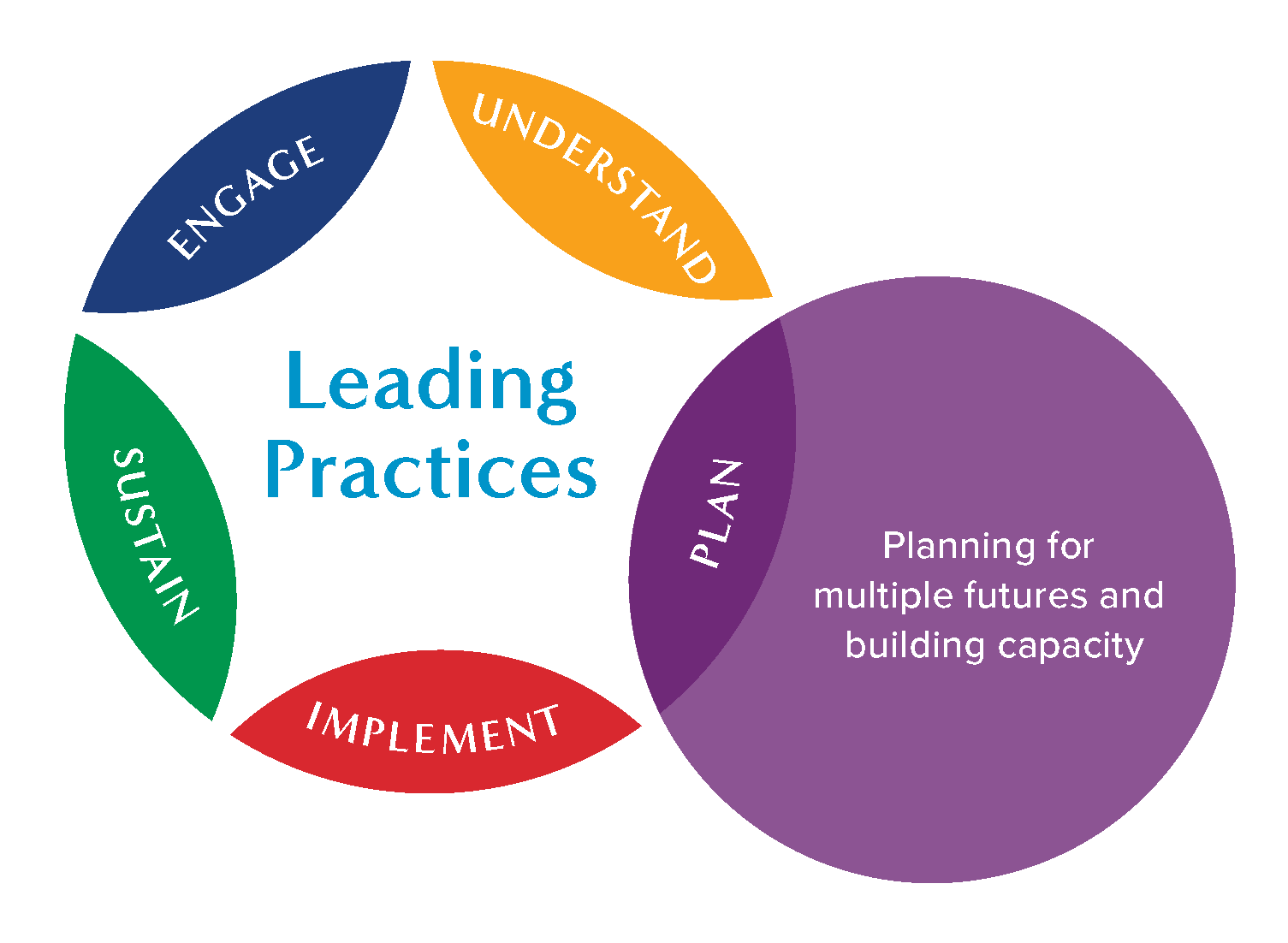
Seeking robust, no-regret and low-regret investments that work across a range of future conditions and identifying solutions for future use helps build adaptive capacity within a utility's operations and investments to prepare for whatever the future may bring.Navigating the planning process in the midst of uncertainty is fundamental to climate adaptation success. The leading practices in the PLAN action area, introduced below, highlight how WUCA members are learning to better assess how changes in underlying conditions impact their systems (e.g., infrastructure, financial, ecosystems, and human resources) and how to plan in a climate change context.
In the PLAN action area, leading practices include:
-
Connect with ongoing or upcoming planning processes
-
Leverage the power of well-placed climate change screening questions
-
Be prepared to be changed by the processLearn from earlier climate change planning efforts
-
Develop tools that allow information customization
-
Take on climate change as another component of risk management
-
Leverage existing funding mechanisms (also in SUSTAIN)
-
Plan for a range of futures, not a single future
-
Employ decision-making science and deep uncertainty concepts
-
Build and maintain in-house capacity (also in SUSTAIN)
PLAN
Connect with ongoing or upcoming planning processes
Climate adaptation can be most effective when worked into ongoing or upcoming planning within a utility, as opposed to creating a separate, standalone document like a climate adaptation plan. Examples of integrating climate adaptation into existing or planned efforts could include:
-
Making strategic suggestions when planning documents are revised;
-
Adding "consider climate change" to planning checklists;
-
Adding language about exploring/evaluating climate adaptations in RFPs and consultant scoping documents; and
-
Providing new data sets/analysis by which planning options can be evaluated
Example: A climate change-focused integrated resource plan
Water Forward, Austin Water's integrated water resource plan(Opens another site in new window), which was adopted in 2018, was developed with a focus on addressing climate change impacts, building on regular utility planning such as the state-required five-year water conservation and drought contingency plans. This 100-year plan evaluated future demands in multiple hydrologic scenarios to identify future demand-management and supply strategies to be implemented by the utility and the community. The plan will be updated every five years as part of the utility's ongoing adaptive water resource management approach. Austin Water staff continue to participate in other planning efforts to facilitate strategy implementation, such as development of a City of Austin Climate Equity Plan, green infrastructure plan, watershed master plan, and the state-required Lower Colorado River Basin regional water plan. These planning efforts have provided an opportunity for greater implementation, as described in IMPLEMENT: Be prepared to act when opportunities arise.
Example: Strategic planning
To recognize climate impacts and the need for adaptation more formally, the Portland Water Bureau included several climate adaptation strategies in the utility's updated strategic plan, described in Example: Concrete impacts of warming temperatures.
Example: Enterprise risk management
Southern Nevada Water Authority did an organization-wide risk analysis to understand the breadth of climate risk. See PLAN: Take on climate change as another component of risk management for details.
ENGAGE
SUSTAIN
Seek out and support climate champions throughout your utility
Progress happens more quickly with the support of motivated individuals who value and prioritize climate adaptation work, including executive-level leaders. It is therefore important to build relationships with and educate champions who can influence climate adaptation actions, then help sustain and strengthen those efforts. Having champions across an organization (in planning, engineering, finance, public relations, and other roles) can contribute diverse expertise and resources and help provide institutional memory as individuals' roles change.
This practice is included under both ENGAGE and SUSTAIN climate adaptation actions.
Example: Building a cross-functional team of champions
The Central Arizona Project (CAP) climate adaptation plan(Opens another site in new window) was developed with an education and engagement mindset, which elevated existing and promoted future climate champions throughout the organization. Key to the development of the plan was the active participation of a cross-functional team of internal experts comprising all of CAP's climate-sensitive functions, including water policy, operations and engineering, maintenance, public affairs, technology, legal services, finance and administration, and employee services. The team collaboratively identified implications of climate change for CAP's functions as well as all components of the CAP climate adaptation plan. This approach helped foster climate champions in each of CAP's organizational functions by actively educating and engaging them in the climate adaptation process. It also gave members of the CAP team ownership in addressing CAP's climate challenges.
Example: Interactive climate education with an organization
One important way to build climate champions is through interactive climate education sessions within an organization. For example, Denver Water includes a "Climate 101" unit in all orientation sessions for new employees and provides climate science, adaptation, and mitigation information in its new employee onboarding package. As part of the Climate 101 education sessions, new employees are given prompts to brainstorm how climate change could impact various utility business functions (finance, water treatment, construction, etc.). This approach gets employees thinking creatively about climate change from day one of the job and establishes a baseline level of climate knowledge. After a Climate 101 session, a new employee of Denver Water's youth education team was inspired to integrate climate change into the youth education curriculum and has since created an entire climate change and water module that is presented to schools throughout the region. Building on the successful implementation of these Climate 101 sessions for new employees, the climate team began offering the sessions to other sections at the utility, usually in groups of three to five people to allow for more interactive conversation. This small scale and interactive approach to climate education has allowed the climate team to build climate champions throughout the organization, as well as to build relationships and co-produce climate adaptation ideas with subject matter experts from many business functions.
Example: A dedicated person to support champions utility-wide
Austin Water has a long history of implementing a variety of climate planning and management measures. While these efforts have traditionally been housed in the Environmental Affairs and Conservation Program Area, climate work has also been done across utility program areas—like Operations, Pipeline Engineering, and Water Resources Management—and, to some extent, in different city departments. In 2019, Austin Water established a new staff position, Climate Protection Consultant, to place additional utility-wide focus on climate issues. This includes taking steps to enhance information sharing about climate change across the utility, continuing to better incorporate climate concerns into cross-functional utility planning efforts, and representing Austin Water on city-wide climate planning initiatives. This position reports to the Assistant Director of Environmental, Planning, and Development Services. This reporting structure provides frequent opportunities for sharing climate-related information with utility leadership. In addition, the Office of Sustainability, a department within the City of Austin, is currently evaluating options for creating a new Chief Climate Resilience Officer position to address city-wide climate resilience planning and strategy implementation.
ENGAGE
Consult expertise throughout your utility regularly and with purpose
Adapting to climate change requires diverse expertise and broad participation, both of which can be gained by consulting others throughout your organization. The type of engagement that works best varies depending on an organization's culture, but a little forethought and some regularity can go a long way (e.g., begin with listening and ask what matters).
Example: Business function conversations
Southern Nevada Water Authority (SNWA) climate adaptation staff initiated a process of engagement with internal experts by first sharing results from a region-specific climate change projection study. At early meetings, department heads learned about the types of changes expected in the future and weighed in on how these changes might impact utility business functions. From these initial meetings, a few key business function areas were identified to develop adaptation actions. Then, SNWA set up small group meetings and interviewed each business function area to gather how the organization's experts thought they could address potential impacts. Conversations were summarized, and each small group reviewed the recommended actions and helped develop next steps. The process accomplished several goals: It educated staff about climate change It introduced staff to SNWA's climate leadership so they know whom to contact in the organization with questions Because business function experts were the ones to develop the solutions, it ensures buy-in and increases the likelihood that proposed solutions will be implemented See Example: Business function mapping to learn about a framework for considering climate change across an organization’s business functions.
Example: Trash removal as an unexpected adaptation need
Adaptation planners at the Philadelphia Water Department (PWD) recognized that successful adaptation requires expertise on both climate science and operations. It is not possible for PWD's adaptation planners to possess all of the necessary operational knowledge for the numerous systems PWD operates and maintains across the city (drinking water, wastewater, and stormwater). So the PWD Climate Change Adaptation Program (CCAP) prioritized engaging in two-way conversations with utility operators early and often to share information and begin developing meaningful solutions/adaptation strategies. For example, PWD's adaptation planners met with operations staff at one of PWD's wastewater treatment plants. After presenting future projections of precipitation increases, the operators shared that these conditions would likely produce more trash, accumulating at faster rates, during the initial screening stage of the wastewater treatment process. This consequence, which was only identified after consulting with plant operators, has implications for resources—more staff and equipment may be needed to remove and process trash to maintain current levels of service.
Example: Utility-wide climate adaptation planning
Preparing a Climate Adaptation Plan provides an opportunity to form a cross-functional team with a clear purpose (see ENGAGE: Seek out and support climate champions throughout your utility).
Important lessons
-
Have well-organized information for people to react to.
-
However, do not wait for the analysis to be perfect—share what you have along the way.
-
Strike the right balance between reaching out to staff and respecting their time.
ENGAGE
Tailor the climate adaptation message for the intended audience
One key to successful communication is knowing your audience(s) and framing your message so it has meaning and value to them. A climate adaptation message that resonates with one individual or group might not "land" with others. Identifying which messages work best is time well spent.
Example: Be clear why climate change matter
Over the past 10 years, the Alliance has homed in on messages that resonate with water utilities to demonstrate the impact climate change could have on critical utility operations and functions. Powerful, clear messages that connect climate change to water utility responsibilities include climate change is water change and warming is here and now.
Example: Messages that resonate with engineers
When the Philadelphia Water Department (PWD) Climate Change Adaptation Program (CCAP) was ready to share information and results from analyses internally, success—i.e., whether climate information would eventually be adopted within existing planning, design, and asset management processes—hinged on good communication. For example, when sharing information with engineers who work on long-term infrastructure plans, CCAP first explained how climate change is altering the water cycle and how climate non-stationarity might challenge standard engineering practices, procedures, and tools. Planners and design engineers are used to working with return intervals and other statistical tools and methods that are based on historic data. It was essential to explain that, because of climate change, these traditional tools and methods may no longer be adequate moving forward. It was also important to convey that the CCAP team is available to help PWD staff tackle these challenges.
Example: Concrete impacts of warming temperatures
Climate change can be an abstract concept for water utility professionals whose daily responsibilities include operating reservoirs, designing and building projects, and managing aging infrastructure. To make climate change concrete, the Portland Water Bureau has identified a spectrum of ways in which climate warming and its impacts affect water utility functions and operations, from engineering and operations groups to finance, communications, and maintenance & construction. For example, climate warming and wildfire smoke directly affect the health and safety of the outdoor workforce. Also, increased risk of flooding and landslides could damage critical bureau assets. Presenting direct impacts to the day-to-day job of construction field crews and asset management engineers has successfully resonated with these staff. To recognize these impacts and the need for adaptation more formally, the Portland Water Bureau has included several climate adaptation strategies in the utility’s updated strategic plan. The utility also gives many internal and external presentations within the water sector, and most of these communications begin by connecting the physics of a warmer atmosphere to the hydrologic cycle. From there it is easier to illustrate how a changing water cycle will affect a given water utility.
PLAN
Leverage the power of well-placed climate change screening questions
One of the first steps to successful climate adaptation is building awareness that future conditions (e.g., weather, sea levels) will be different. While there is often not a clear answer to how big changes will be, a lot can be done by getting decision makers to pause and consider how they might adjust. This could be as basic as inserting climate change screening questions into key planning processes.
PLAN
Be prepared to be changed by the process
Grappling with climate change and planning for adaptations can inspire new ways of thinking that could alter how you plan within your organization, whether for climate, land use, population, or other significant future changes.
PLAN
Learn from earlier climate change planning efforts
Over the past 10+ years, many utilities have started planning for climate change. Their efforts have resulted in both missteps and innovations worth learning about, such as trainings, case studies, and these leading practices.
ENGAGE
Include equity from the beginning
Effective solutions to climate change challenges depend on many factors, all of which might not be clear at the onset. Engaging and focusing on the needs of communities, particularly those most vulnerable to disruptions caused by climate impacts, is best done at the beginning and throughout a project. By improving conditions for the most vulnerable in your community, you also improve conditions for everyone.
ENGAGE
SUSTAIN
Make the business case for climate adaptation
Improving resiliency takes time and resources but can also save time and resources. Transparency about financial elements, including tradeoffs in costs and other triple-bottom-line benefits — social, environmental, and financial — can motivate action and demonstrate how adaptation investments can save money in the long run. This helps engage people from the beginning and sustain the effort.
This practice is included under both ENGAGE and SUSTAIN climate adaptation actions. See examples in the SUSTAIN section.